01
Intelligence Platform
The AI brain
GrayMatter Intelligence Platform
Connect · Predict · Decide · Act
Connect · Predict · Decide · Workflow · Copilot · Insights · Analytics · Agent Studio · Specialist Agents
Colour theme
Signature
Professional
Dark
Expressive
01
Bring it.
Show it.
Build it.
Ideas to
intelligence
to impact
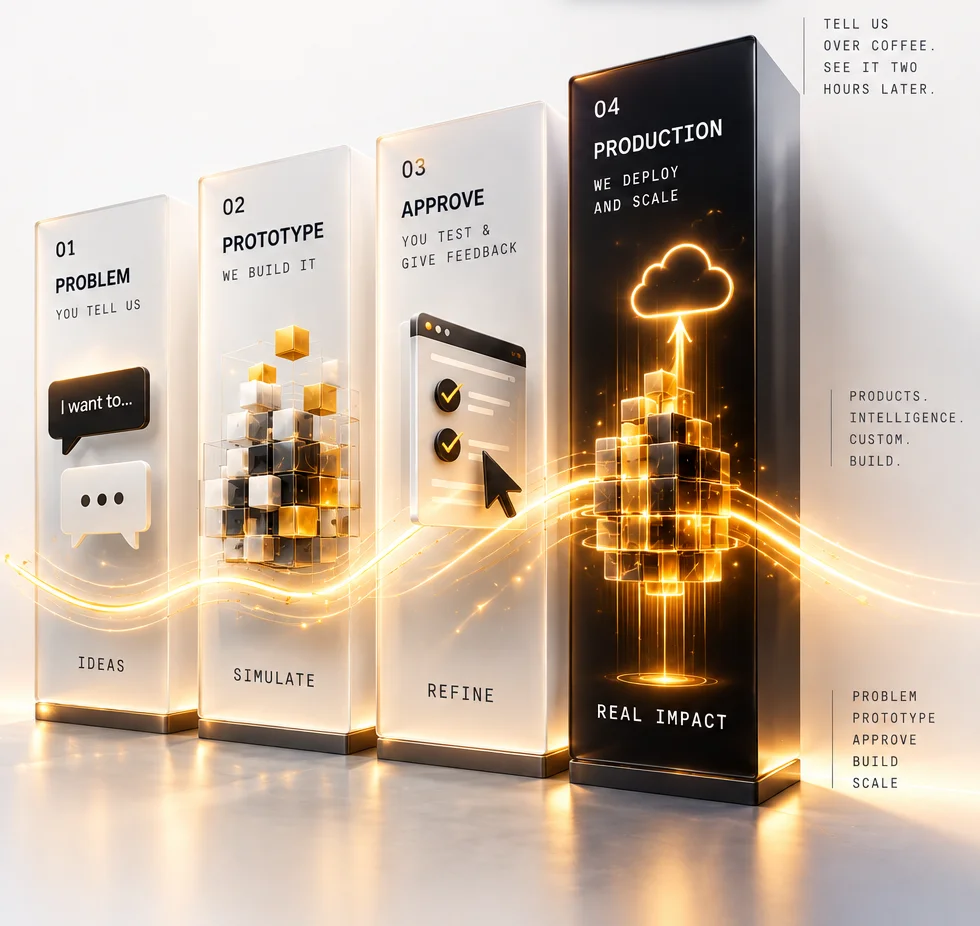
Tell us what you want to build, automate or fix. We turn it into something you can click, test and argue with, before you commit to anything. Like it? Approve it, and we take it into production.
GrayMatter Technologies is an AI and software development company in Hyderabad, building for education, healthcare and mid-sized business from CoKarma in Kondapur.
You describe the problem over one coffee. Two to three hours later, there is something on a screen for you to react to. Not a document. Not a deck. Something you can click. If there isn't, we haven't understood the problem yet, and that is on us.
Prototype within 03:00:00
2–3 hrs
from the conversation to a prototype you can click
7 days
from the approved prototype to a production application
₹0
for the first prototype. You pay for the build you approve.
Three ways in
However you want to start, start. Buy a product, adapt it to your organisation, or bring us the thing nobody has built yet.
01
Buy it
Ready-made products for the things most organisations need: a CRM, documents, procurement, a campus system, a service desk. Built to be used on day one.
See the products02
Adapt it
Your approval chain, your fields, your reports, your integrations. A product is a starting point, not a constraint you reorganise around.
How we work03
Build it
Describe it. We prototype it, you test it, and if it is right we build it. The catalogue is not the limit of what you can get from us.
Build my prototypeHow we work
Five steps, in that order, every time. The prototype comes before the commitment, and the build after it runs to seven days.
04 · Build The 7-Day Build
What would you build?
While companies spend months writing requirements and comparing vendors, you could be clicking through the thing itself. Describe it in a sentence. That is all we need to start.
Worth prototyping
One ecosystem
An intelligence layer, the applications that run the organisation, and the people who build what is missing. One company, one way of working, not fifteen vendors.
Every product below is available today.
01
The AI brain
GrayMatter Intelligence Platform
Connect · Predict · Decide · Act
Connect · Predict · Decide · Workflow · Copilot · Insights · Analytics · Agent Studio · Specialist Agents
02
The systems that run the business
03
The intelligent campus
04
Where work gets done, signed and resolved
The model
Four stages, in order. Most tools stop after the second and leave the hardest part to a meeting. Watch one signal carried all the way through.
Illustrative example · Diagram — sample data, not customer data.
Your systems already hold the answer. They just hold it separately.
ERP, CRM, HRMS, finance, spreadsheets, the export someone emails every Monday. GrayMatter reads them together so a signal in one system can be seen by the rest.
A dashboard reports the past. A forecast has an opinion about the future.
One forecasting approach pointed at whichever question matters: demand, revenue, admissions, attrition, cash, capacity. Every forecast carries its reasoning and how confident it is.
A number is not a decision. Someone still has to say what to do about it.
The decision layer weighs the forecast against cost, risk and constraint, and returns a specific recommended action with the reasoning attached, so a human can accept it, change it or reject it.
Most insight dies in the gap between the meeting and the task.
Once a person approves, the decision becomes work: the request raised, the team notified, the workflow moved, the outcome tracked. Nothing executes without an approval that is recorded.
The fourth stage is the one that matters and the one almost nobody ships. See each stage in detail
The AI brain behind all of it
One surface does most of the work: a place where leadership sees the business as it is, with the recommendations waiting for a human decision, and the capacity their people got back.
Revenue, next quarter
₹18.4 Cr
+6.2%
High confidence · 14 quarters of history
Demand, next 30 days
−12%
Falling
Medium confidence · seasonality adjusted
Cash runway
47 days
Clear
High confidence · 3 inflows pending
Capacity released
1,240 hrs
68% redeployed
Quarter to date · Human Opportunity Index
Decision trail
Every step is attributable. Nothing executed without the approval above it.
Illustrative example · Mid-market manufacturer — sample data, not customer data.
Read the tiles carefully
Three of those four numbers are the ones every executive already asks for. The fourth, capacity released and how much of it was redeployed, is the one almost nobody measures, and it sits there as an operating metric rather than a footnote. That placement is the argument.
Machine intelligence
Human opportunity
The Human Opportunity Initiative
AI takes work away from the people who have it, and changes what the people entering work need to know. We are building for both: a way to measure what an organisation does with the capacity AI frees, and a pathway that takes graduates from potential to profession.
AI will remove work. The question is what you do with the capacity it creates. We built a framework to measure it, and we publish it as a draft because it is one.
01
AI takes the repetitive work — the chasing, the reconciling, the re-keying, the reporting.
02
Hours come back. This is the moment everything hinges on, and it is the moment almost nobody measures.
03
Those hours are deliberately moved into judgement, creativity, relationships, strategy and problem solving.
04
New skills, changed roles, work that did not previously fit into anyone's week.
05
Revenue, quality, innovation and customer experience improve because capable people finally have room to do the work only people can do.
Capacity cut from a business is banked once and never earns again. Capacity redeployed into higher-value work keeps producing. A company that treats automation purely as a cost event takes a single-year gain and loses the institutional knowledge that was going to compound. We think that is a bad trade, and we think it will look obvious in hindsight.
We are not claiming that no role ever changes, that automation is painless, or that every company will choose redeployment. We are also not claiming to have proven any of this yet. What we are doing is building the measurement into the product from the start, so the question is at least on the table when the decision gets made.
Where we go deep
Domain knowledge changes the answer in both. Here is what we build for each, from ready-made products to the intelligence layer to things nobody has built yet.
Schools · Colleges · Universities
Admissions, student success, faculty productivity, accreditation and placement — where the decision that matters usually has to be made a term before the data confirms it.
Hospitals · Specialty clinics
Operations, revenue leakage, patient journey, workforce and administrative load — the parts of a hospital that are not clinical decisions and absorb an extraordinary amount of clinical time.
Outside those two
The approach is not industry-specific, and we will take on a well-defined problem in Manufacturing, Retail and distribution, Logistics, Financial services or Professional services. We have not built domain depth there, and we will say so rather than imply otherwise.
Why GrayMatter
Not advantages. Positions. Each one costs us something, which is how you can tell we mean them.
01
You should see the thing before you decide about the thing. So we do not open with a document. We open with something you can click, and the commercial conversation happens after you have tested it, not before.
Instead of: a forty-page proposal
02
The intelligence layer, the applications that run the organisation and the people who build what is missing come from one company with one way of working. When something does not fit, the answer is a prototype, not a procurement cycle.
Instead of: integrating six suppliers
03
The system recommends; a named person decides, and the approval is recorded against everything that follows. Anything touching clinical or student outcomes is advisory to a qualified professional, always. This is a design position, not a limitation we intend to remove.
Instead of: automation nobody can interrogate
04
Every vendor will tell you how much work they removed. We think that number is meaningless on its own, so we measure what your people did with the capacity, and we are building a pathway for the people trying to enter work at all.
Instead of: counting jobs removed
The founder

I spent fifteen years inside large, complicated organisations watching them spend months deciding what to build, and then discover the real problem was different the moment someone actually used it. It was never a shortage of intelligence. It was distance: between the person who understood the problem, the document that described it, and the thing that finally got built. GrayMatter exists to close that distance, and to be honest about what it does to the people whose work changes as a result.
Sudheer Akella
Founder & CEO · GrayMatter Technologies
Where that experience was earned — prior employers, not GrayMatter customers
GrayMatter has no customers to name yet. When it does, they will appear somewhere clearly marked as customers, and only with their permission.
Straight answers
Including the uncomfortable ones. We would rather lose the deal early than lose your trust late.
Something you can click. Real screens, your workflow, your terminology, enough working logic to test whether the idea holds. It is deliberately not the production application: it has sample data rather than your live systems, and it proves the shape of the thing rather than every edge case. You use it, you tell us what is wrong, and that feedback is what the build is scoped from.
Yes. The first prototype costs you nothing, and so does the conversation before it. You pay only when you approve the prototype and we build the production application, which is fixed-scope and fixed-price and runs to the 7-Day Build. If the prototype shows the idea was wrong, you have lost a coffee and gained an answer.
This is the right question and it deserves a contractual answer, not a reassurance. Our position: your data stays exportable in open formats at any time without asking us, the pilot is scoped so nothing critical depends on us within the first engagement, and exit terms are written into the agreement before work starts. For anything beyond a pilot we will discuss source escrow. If a vendor cannot tell you how to leave them, that is information about the vendor.
You may not. Business intelligence answers what happened and, done well, it answers it beautifully. If your problem is that nobody can see the numbers, buy a better dashboard. Our argument starts one step later: you can see the number, it is still taking three weeks to act on it, and that gap is costing you. If that is not your problem, we are not your purchase.
No, and we are not going to imply otherwise. We build to the practices those standards describe — least-privilege access, encryption in transit and at rest, audit logging, data minimisation — and we will pursue formal certification as engagements require it. If certification is a hard procurement gate for you today, we will not pass it.
Every question, including what happens if we go out of business
Start here
A sentence about what is slow, manual or missing is enough. We come back with a view on the fastest useful thing to put in front of you, and an honest answer on whether we are the right people to build it.